

Our Strategy
🔹 🔹We Connect People with Possibilities.🔹 🔹
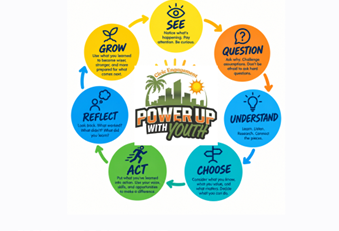
Power Up With YOUth helps young people and communities see what’s happening around them, ask questions, understand what they discover, connect with people who can help, and find meaningful ways to contribute.
We don’t assume we have all the answers. We start by paying attention, listening, and learning. We explore what’s already happening and consider what we can do together.
🔹🔹OUR LEARNING & ACTING CYCLE🔹🔹
Our approach is a cycle. Every action gives us something to learn from. Every experience can help us see more clearly, ask better questions, and discover new possibilities.
🔹 SEE THE BIG PICTURE🔹
We begin by paying attention to the world around us.
What’s happening in our schools, neighborhoods, and communities? What do young people notice? What are people experiencing? What strengths, challenges, and possibilities might we be overlooking?
We go where people are—in schools, youth organizations, community gatherings, neighborhood conversations, and events with local leaders.
We listen, observe, and look beyond first impressions.
You can’t understand what you haven’t taken the time to see.
🔹 QUESTION WHAT YOU SEE 🔹
🔹 Be curious. Ask why.
Questions help us move beyond assumptions.
Why is this happening? Who is affected? What do people know about the situation? What don’t we know yet? Whose perspective have we not heard?
We encourage young people and adults to ask questions, listen to different viewpoints, and remain open to what they might discover.
We don’t have to know the answers before we begin. We do have to be willing to ask.
Curiosity opens the door to understanding.
🔹 UNDERSTAND THE ANSWERS🔹
Listen, learn, and consider the whole picture.
We seek to understand the people, circumstances, experiences, and information connected to what we’ve observed.
We listen to people who are affected. We learn from those with relevant knowledge or experience. We explore information and consider perspectives that may differ from our own.
Understanding doesn’t require us to agree with everyone. It requires us to make a genuine effort to see more than one side and think carefully about what we’ve learned.
Seeing comprehensively helps us understand. Empathy helps us care. Wisdom helps us decide what to do.
🔹 CHOOSE 🔹
Find the helpers. Build bridges.
We look for people, organizations, institutions, information, resources, and opportunities that can help.
Some helpers are already working on the issue. Others have specialized knowledge, useful skills, relationships, or resources to share. Young people may have ideas and abilities that others need, too.
We meet people where they are and help connect people who might benefit from knowing one another.
Sometimes the right connection is a community organization, a professional, a school, a local leader, or someone who knows where to find the information we need.
We don’t assume we have to do everything ourselves. We discover what’s already happening and look for ways to bring people and possibilities together.
Good connections can turn what we’ve learned into opportunities for action.
🔹 ACT WITH CONNECTION🔹
Take a meaningful next step.
Once we’ve learned more and explored our options and considered what to do. we take the next right step.
Should we share information, ask another question, join an existing effort, help someone find a resource, bring people together, or lead an activity of our own?
Not every situation calls for the same response. We consider what matters, what we’ve learned, who can help, and what we have the capacity to do.
Sometimes we lead. Sometimes we collaborate or support the work of others. Sometimes the most useful action is making a connection.
We don’t have to do everything. We can choose a next step that makes sense and follow through.
We do the next right thing.
🔹
🔹
Look back. What did we learn?
After taking action, we pause to consider what happened.
What worked? What didn’t? Who benefited? What surprised us? What did we learn about the issue, the people involved, or ourselves?
Reflection helps us recognize progress without pretending everything went perfectly. It helps us acknowledge mistakes, learn from experience, and consider what we might do differently next time.
We can celebrate what went well, take responsibility for what didn’t, and remain open to new information.
Every experience gives us something to learn.
🔹GROW🔹
Use what you learn to move forward.
Growth happens when we put learning to use.
We may develop new knowledge, skills, relationships, confidence, empathy, or a better understanding of our community. We may discover a different way to approach a problem or recognize an opportunity we hadn’t seen before.
Growth doesn’t mean we have everything figured out. It means we’re better prepared to keep learning, make thoughtful choices, and contribute.
And as we grow, we begin to SEE more than we saw before.
The cycle begins again—with new understanding, new questions, and new possibilities.
Breathe. Regroup when you have to. Do the next right thing—together.
🔹OUR CYCLE APPROACH IN PRACTICE🔹
Our approach can take many forms.
🔹In schools and youth organizations: We connect young people with people, projects, and opportunities to apply what they’re learning.
🔹In our communities: We listen to residents, ask questions, conduct surveys, and learn what matters to people.
🔹Through civic participation: We help people explore how communities work and discover meaningful ways to participate.
🔹Through community projects: We connect people with expertise, technology, organizations, and resources that can help them investigate concerns and explore solutions.
🔹Through partnerships: We work with people and organizations already doing meaningful work, looking for ways to connect strengths and support progress.
The activities may differ, but the process remains the same: see, question, understand, connect, act, reflect, and grow.
🔹WE POWER UP TOGETHER🔹
Young people bring ideas, questions, talents, and perspectives. Community members bring experience and knowledge. Organizations offer resources and opportunities. Helpers bring skills, relationships, and expertise.
When we connect these strengths, we create more opportunities to learn, contribute, and make a difference.
We don’t have to know everything or do everything ourselves. We can begin where we are, learn from one another, and take the next right step.
Power Up With YOUth. It’s your world, too.
Use your powers for good. Do the next right thing.